
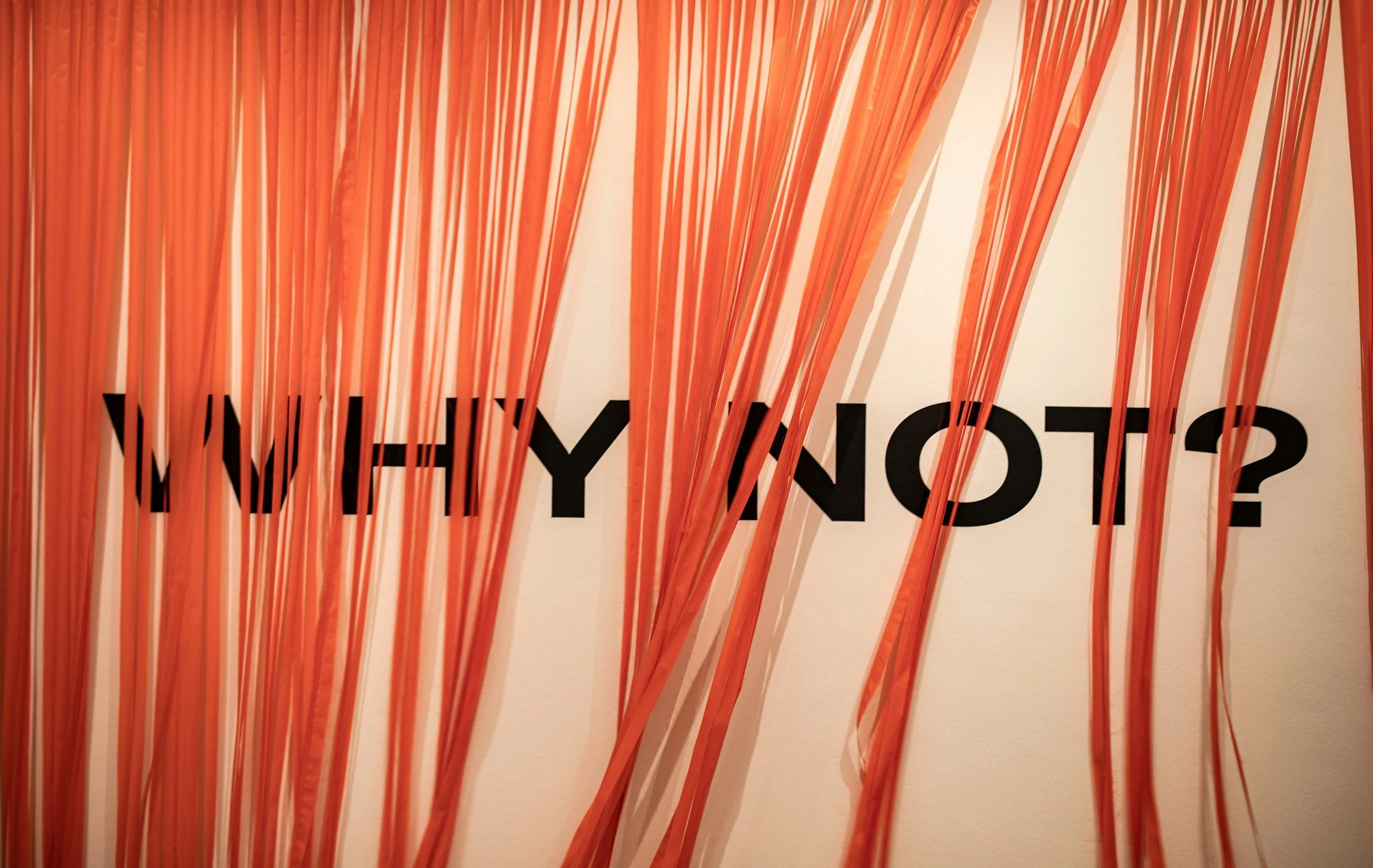
Why Not Why?
Why one of our favorite open-ended questions can sometimes shut down the very curiosity we’re trying to create
It’s no secret that many of us coaches are passionate proponents of open-ended questions. When folks comment that my leap from engineering to coaching feels like a big one, I usually reflect that the common throughline is curiosity and incessant enthusiastic questioning.
I’m certain that, as a child, I drove my parents crazy with unending “why” questions. They always encouraged me to question, and I have to give credit where it’s due, because I’m sure it’s easier to say, “because that’s just the way it is” or “because I said so” after even a few rounds of “Okay, but why?”
In coaching, we know that not all questions are created equal. Much of coach training is centered around how to remain truly curious and how to ask powerful, thoughtful questions. A well-placed question can unlock an entirely new horizon of insight for a person or a team. A poorly worded or mistimed one can shut down inquiry and break trust.
There’s an entire body of work devoted to how we ask, listen, inquire, and help people think. Some of my favorite books on leadership, coaching, persuasion, and human behavior explore this from different angles, including Humble Inquiry, The Coaching Habit, Warren Berger’s books on beautiful questions, and How Minds Change. I’ll come back to those in a separate reading list later this month. For now, I want to focus on one deceptively simple question in particular.
“Why?”
Open-Ended Doesn’t Always Mean Expansive
Anyone who has worked with me will know that I’m a big fan of open-ended questions. How do we define an open-ended question? Well, it’s the inverse of a closed-ended question.
I kid. (Sort of.)
If a closed-ended question is one that can be answered with a binary yes/no, then an open-ended question is one that cannot. But I think the subtlety is a bit more complex than that.
I might ask you, “How many vacation days do you plan to take this year?” or “What color is your pen?” Sure, these might both be structured as open-ended questions, but they don’t really lead to deeper understanding.
Compare those with:
“How do you decide the number of vacation days to take?”
“How do you feel about your planned vacation this year?”
“What makes red your favorite pen color?”
“How does the color red make you feel?”
Those questions elicit more understanding rather than simply delivering a deterministic fact. Closed questions in conversation often lead us to dead ends, while good open-ended questions can expand the conversation.
That’s not to say closed questions don’t have a time and a place. They certainly do.
“Is the valve open or closed?”
“Is it safe to proceed?”
“Do you have your passport with you?”
Those are all situations where we’d want a solid, definitive answer.
And yet, people so often default to a closed question when an open question would work much better.
“Do you feel comfortable?” vs. “How comfortable are you feeling?”
“Does that make sense?” vs. “How is that landing for you?”
Even in emergency management situations, where the stakes are high and the timelines are tight, on-scene commanders are taught to ask, “What have I missed?” instead of “Have I missed anything?”
We can even see the value of embracing open-ended questions in our own self-narrative:
“Will I succeed or will I fail?” vs. “How many attempts will this take?” or “What might work?”
“Is this good or is this bad?” vs. “How am I determining success here?”
“Should I stay or should I go?” vs. “What are my ‘continue’ vs. ‘quit’ criteria?”
So when we think of open-ended questions, we typically think of the familiar “Five Ws + H” of journalism, storytelling, and problem-solving: Who, What, Where, When, Why, and How. But even within that group, not all questions are created equal. One of those W questions can be a bit riskier than the others.
And that question is “Why?”
What Makes “Why” Different?
I know, I know. I can hear all my engineers, investigators, scientists, and Simon Sinek fans gasp in horror.
Why is often seen as the ultimate inquiry question. Root Cause Failure Analysis (RCFA) and incident investigations often use a series of Five Whys to uncover initiating factors and underlying causes. Simon Sinek’s Golden Circle framework puts “Why” at the center, with the “How” and “What” following from it.
And I do not disagree! “Why” can be an incredibly powerful tool for exploration and understanding.
But when we use it in conversation with another human being, it can operate differently. We aren’t investigating a failed pump or tracing a process deviation. Instead, we’re interacting with people who are navigating cognitive biases, identity threats, social dynamics, past experiences, and assumptions about what the person asking the question actually means.
That’s one reason that, in coaching, we often favor “What” and “How” questions over “Why.”
Think back to the last time someone asked you, “Why did you do it that way?” At best, you might genuinely reflect on your choices and explain your reasoning. At worst, you may hear something closer to, “What on earth were you thinking?”
As an engineer, I am deeply curious about people’s methodologies and am always looking to update my own “SOPs” (Standard Operating Procedures). The irony is that, even when I am truly seeking to understand, asking, say, my husband, “Why did you load the dishwasher that way?” will often come across as critical or accusatory.
Without any other framing, I’m reasonably likely to get something back like, “I don’t know, Erica. How would you like me to load it?”
Asking why can subtly communicate that someone’s choice wasn’t obvious, wasn’t what we would have chosen, and therefore now requires an explanation.
And explanation can very quickly become justification. (*Cue the suspenseful pre-reveal sound*)
When “Why” Turns Into Justification
In coaching, where we are striving to deepen understanding and self-knowledge, we will often reframe those questions.
Instead of, “Why is this important?” we might ask, “What makes this topic important for you?”
Instead of, “Why didn’t that action item get done?” we might ask, “What got in the way of that intention?” or, “What could have set you up for success better?”
Instead of, “Why do you think that?” we might ask, “How are you assessing this situation?”
While the intent behind the question may be almost identical, the psychological experience of answering the question can vary drastically.
The fascinating part is that even when our intent is simply to have someone reflect objectively on their choices or decision-making process, a “why” question can push the conversation in the opposite direction.
People may, consciously or unconsciously, start constructing a rationale that makes their choice seem sensible. If that rationale is challenged, they may become more committed to defending it. None of us particularly enjoys feeling irrational, inconsistent, or bad at decision-making, so there is a strong incentive for the brain to come up with reasons. (See also: “Escalation of Commitment” and “Confirmation Bias.”)
Scientists Hugo Mercier and Dan Sperber offer an interesting lens on this. In their 2011 paper, Why Do Humans Reason? Arguments for an Argumentative Theory, they proposed that human reasoning evolved not simply to help individuals objectively evaluate facts and reach better conclusions, but also to help us develop and evaluate arguments within social groups. They explore this idea further in their book The Enigma of Reason.
Whether or not we adopt their theory wholesale, the dynamic is easy to recognize in everyday life: ask someone to justify a position, and they often become better at defending the position.
We see this happen in real time throughout the workplace in impactful ways. For example, when clients receive developmental feedback or criticism that they disagree with, I often encourage them to avoid immediately asking “why.”
Let’s paint the picture of receiving a performance rating you don’t understand and asking your manager, “Why did you rate me this way?” The manager now has a problem to solve. They need to answer your question. So they search for reasons. In fact, they may begin assembling a laundry list of examples to justify the feedback, even if those examples don’t represent the whole picture. Now we’ve anchored that person in negative memories and potentially further solidified the rating. And once they’ve articulated and defended the case, disagreement or contradictory evidence from the employee can easily sound argumentative or resistant to constructive criticism.
Compare that with questions such as:
“What would that look like if I’m doing it well?”
“How do you typically assess that?”
“What would you need to see from me to evaluate this differently?”
Or even: “Who in the organization really excels at this?”
Those questions can generate far more useful information. They may also cause the assessor to examine their own standards, evidence, and assumptions without anyone needing to point out the potential biases or logical fallacies.
Try Changing the Question
Even when we are evaluating our own behavior or patterns, shifting from “Why” to “What” or “How” can change the nature of the inquiry.
“Why do I keep waiting until the last minute?” becomes “What’s actually causing this pattern?”
“Why do I get so frustrated?” becomes “What’s important to me here?”
“Why do I feel like this?” becomes “What’s actually going on here?”
This may sound trivial, or like semantics, but we know that words matter, and practice, it can represent a meaningful shift from judgment toward investigation.
Now, I should probably note that I’m not suggesting you remove the word why from your vocabulary entirely. The next time you’re tasked with assessing the root cause of a compression plant trip, by all means, reach for your handy Five Whys tool. And the next time you’re searching deeply for the purpose underneath an endeavor, feel free to start with why.
But the next time you are seeking to understand a human, perhaps reach for one of the other powerful open-ended options.
“What” and “How” are right there, waiting to help.
And if you’d like to sharpen your own questioning repertoire, keep an eye out for our next August blog post. We’ll be sharing several of our favorite books on asking better questions, listening more effectively, and creating the kind of inquiry that helps people think rather than simply defend what they already believe.
PS: We use Bookshop.org affiliate links, which means that purchases made through these links may earn a small commission for Two Piers at no extra cost to you, helping support our work.