

A Thanksgiving Reflection on Gratitude, Leadership, and Savory Bread Pudding
Thanksgiving can be a complicated holiday. The history is whitewashed. The family dynamics can be messy. The expectations to perform warmth and connection are real. And the intense barrage of consumerist messaging can be absolutely exhausting.
And yet… it remains my favorite holiday of the year.
Granted, a big part of that is due to my love of cooking. It has been one of my longest sustained special interests. I love the science behind it and the creativity of it. I love the sensory elements and the exploration. But ultimately, the act of preparing and sharing food has always been one of the most natural ways I know to connect with my fellow humans and express my love for them. As an introvert, it lets me show up for the people I care about without the pressure of gift exchanges, crowded rooms, or “performing” social niceties. I get to channel my attention, effort, creativity, and affection into the meal as a medium to carry it forward, (while squirreling away safely in a kitchen).
This year, though, I’ve been thinking about Thanksgiving in a slightly different way. I spend a good portion of my professional life talking with leaders about effective practices and habits, and cultivating gratitude is one of them. (Side note: we mean genuine gratitude, not the performative, empty affirmation kind). I talk about its role in psychological safety, its ability to reset activated nervous systems, and the way it strengthens connection across differences.
And in study after study, the research is pretty clear on this front.
What the Science Says About Gratitude
Y’all know I love a good nerdy data deepdive. It turns out that gratitude is one of the most reliably validated practices in psychological research. Across meta-analyses and randomized controlled trials, the findings are remarkably consistent:
Gratitude is strongly associated with lower depression and reduced anxiety
Structured gratitude practices (like journaling or intentional expression) significantly improve emotional well-being
Gratitude activates the brain’s reward centers and calms the nervous system
It strengthens resilience, optimism, and relational connection across diverse populations
Practicing gratitude as both a state and a trait meaningfully improves psychological and social health
Scroll to the bottom for a list of my sources. And if you want a quick, accessible overview that you can listen to, here’s a link to a Notebook.lm audio summary of the research.
Because I talk about gratitude and mindset so often in my work, I’m taking a moment to practice what I preach. This holiday feels like an opportunity to pause, notice, and name the things (and people) that are holding me up and holding me together.
What (And Who) I’m Grateful For
This year has been full, sometimes overwhelmingly so (as anyone trying to squeeze a meeting onto my calendar lately can attest). But the common thread running through the entire year is the sheer privilege of the work I get to do.
Every week, I sit with leaders and trailblazers who are pushing through uncertainty, solving real problems, building humane workplaces, and wrestling with hard questions about fairness, integrity, and impact. I get to witness that glorious “penny drop” moment when a new insight emerges, or a long-held belief begins to shift and loosen its grip. I get to see brilliant, committed people grow into their potential, often in ways they didn’t think were possible.
This work can be transformational, but it doesn’t happen without trust. People let me into the messy middle of their leadership journeys (the confusion, the frustration, the hope, the expectations), and I do not take that for granted. Every time a client says, “You know, this is actually way more effective than I’d expected,” I’ll usually crack a joke about loving to outperform a low expectation, but on the inside, I recognize what that means. They took a chance on me and on this notion of coaching, and that (sometimes tentative) trust enabled us to make immense progress.
This remains, hands down, the most fulfilling work I have ever done. I am so grateful to have found my calling.
Beyond the work, there are other facets of my life that deserve naming; facets that enable me to show up and do the work that I get to do:
Friends scattered across the world, many of whom I don’t talk to nearly as often as I should, but who somehow know exactly when to send a perfectly timed meme or a ridiculous cat photo that snaps me back to center.
The foster cats and companion animals who have been my teachers in self-worth, presence, patience, play, and the beauty of simply being exactly who we are.
A partner who brings steadiness and humor, who listens with genuine care, who can locate all the misplaced things I’m convinced have vanished forever, and who gently reconnects the train of thought that derailed somewhere between the kitchen and the porch.
Fellow coaches, colleagues, and my professional community, who have believed in me, invested in my growth, had my back in challenging moments, and pushed me to level up again and again.
Our neighbors and this lovely, tightly knit Maine community, who welcomed us with warmth, generosity, and an ease that made it clear we’d found our forever home.
I find so much value in naming these things. It is humbling, and it is grounding, and it is strengthening. I always joke that resilience is a team sport, and I am so so grateful for my resilience-fostering “team.”
Closing With Intention
Thanksgiving is complicated. It can be heavy. It can be stressful. It can be lots of things to lots of people. Hopefully, it can also be a moment to connect, to reflect, and to practice a bit of grounded gratitude that can sustain us beyond a single day, well past when the dishes are washed and put away, and the leftovers have been exhausted.
So here’s my reflection:
I’m grateful for the people in my life, the work I get to do, the communities that hold me, and the small moments of joy that keep me human.
Whether your holiday is quiet, chaotic, delicious, contemplative, or something in between, I hope it brings you warmth, rest, and a moment of genuine gratitude.
And Now, the Bread Pudding
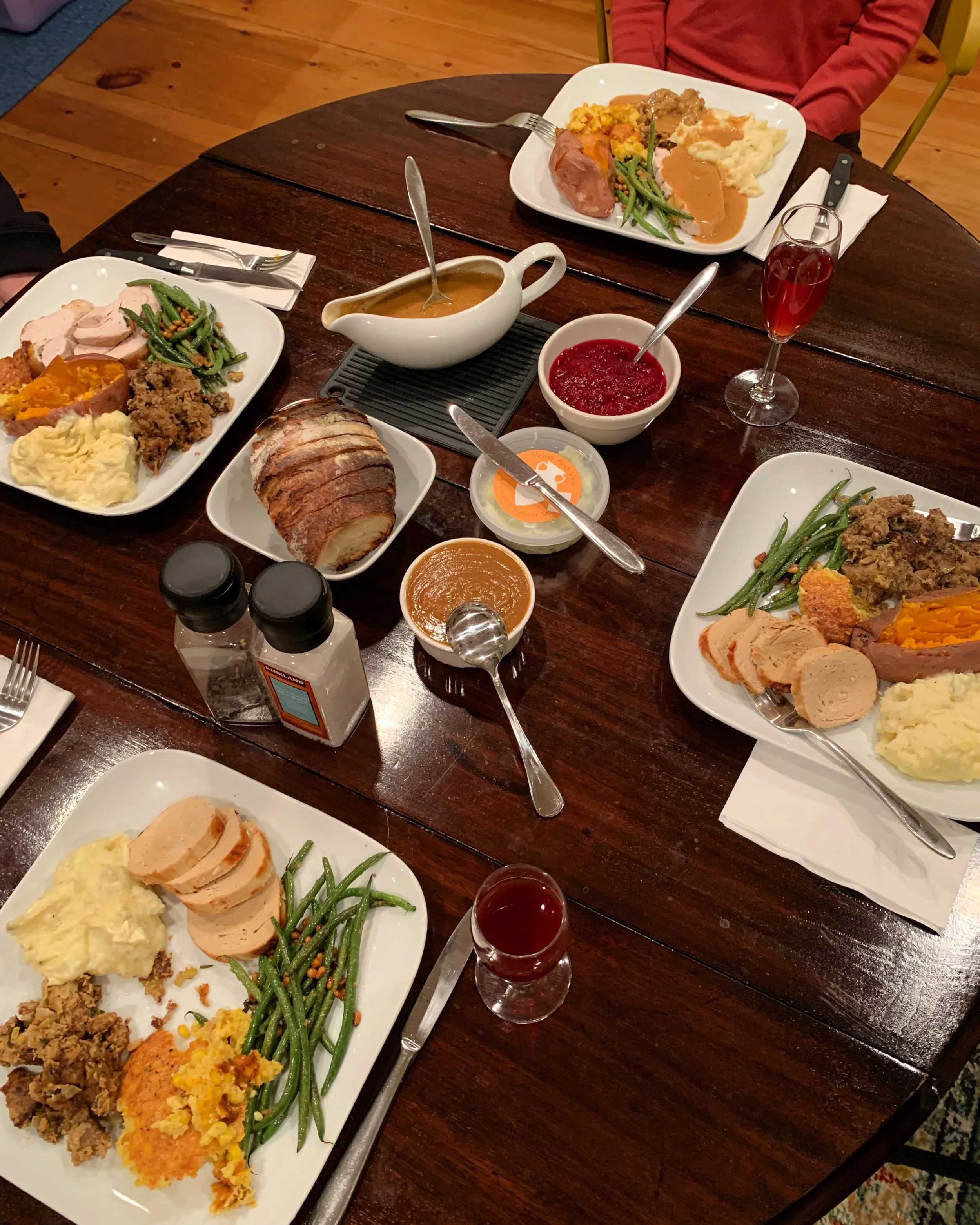
One of our typical vegetarian Thanksgiving spreads.
Since I’m embracing the spirit of the holiday, I want to share the dish I make every year: a savory bread pudding that’s taken on a life of its own and has become a favorite amongst friends and family. It’s vegetarian, but even the omnivores ask for seconds.
The original inspiration came from an old Emeril recipe years ago, but at this point it’s barely recognizable. These days, I mostly wing it. So consider everything here a loose set of guidelines rather than a strict recipe. Follow your heart, follow your gut, and trust that this dish is extremely forgiving.
PS: I included a list of ingredients in the expandable accordion below, but I suggest trying to use whatever you’ve got in the pantry, fridge, freezer, or countertops. This is a great medium to make use of what you have, rather than going out and buying more stuff.
-
Use this as a baseline and adjust as your heart, pantry, and CSA dictate.
Bread & Base
1 hearty seeded loaf or rye (cubed + dried)
6–8 eggs (fresh from a chicken’s cloaca if available, store-bought if not)
2–3 cups heavy cream, half-and-half, or a mix
Optional: dash of Worcestershire sauce (skip if keeping vegetarian)
Aromatics & Veg
1 large yellow onion, diced
2 stalks celery, sliced thinly
2–4 garlic cloves, minced
2–3 cups wild mushrooms (fresh or rehydrated dried mushrooms)
Fresh herbs: thyme (or any herbs you like)
Seasonings
Seasoned salt
Black pepper
Grains of Paradise (if you can find it)
Coriander (optional)
Optional Protein
1 package Impossible Savory Ground (browned)
or breakfast sausage / spicy Italian sausage (if not vegetarian)
or skip entirely
Other
Butter (for sautéing + greasing the dish)
Reserved mushroom soaking liquid (if using dried mushrooms)
Optional: breadcrumbs for dusting the dish
Savory Thanksgiving Bread Pudding (Not Quite a Recipe)
Bread
I prefer a hearty seeded loaf or a rye; something with a bit of structure and depth. I’ve tried sourdough in the past and I didn’t love it in this usage, so I steer clear.
If I’m organized enough, I’ll cube the bread and let it dry out on the counter overnight. If not, I cube it and toast it on low heat to dry it out. (Toasted and stale are not the same thing, but in this case, either works.)
Preheat
Start by preheating your oven to 350°F (177°C, 450 Kelvin for you nerds out there).
Custard Base
Eggs are best fresh from a chicken’s butt (cloaca, technically), but if you don’t keep a flock of needy, pampered, female dinosaurs in your backyard, store-bought works just fine.
I use heavy cream if I have it, half-and-half if I don’t, or a combination of both. Sometimes I'll add a dash of Worcestershire sauce for depth. Just remember it contains anchovies, so skip it if you're keeping the dish strictly vegetarian.
Side note: If you’re tempted to throw cheese in here (as Emeril does), be aware that most cheese is made with animal rennet. If you want this to remain a vegetarian dish, look for cheese made with microbial rennet.
Whisk the eggs, dairy, seasonings, and optional Worcestershire together until well combined.
Aromatics + Veg
I use:
1 large yellow onion - diced, (maybe some leeks if I’ve got them)
2 stalks of celery - finely sliced so they melt away
A few cloves of garlic - chopped, minced, crushed, whatever
A few tablespoons of butter for sautéeing
Fresh wild mushrooms when I’m lucky enough to have them
Dehydrated wild mushrooms from Costco when I’m not
If using dehydrated mushrooms, rehydrate them and reserve that liquid! It’s very flavorful, and you may need it later if the bread needs more moisture during baking. If you don’t need it, you can freeze it to use later in stock or soup.
I typically stick with fresh thyme for herbs, but any combination of herbs you like will work, (parsley, sage, rosemary, go wild).
Season generously with:
Seasoned salt (I’m a Lawry’s girl, but Penzey’s is a favorite as well)
Black pepper
Grains of Paradise (if you can find it, it’s worth it - just treat it like black pepper in a grinder)
Coriander is also a great addition
Optional Protein
I usually add Impossible Savory Ground for a vegetarian-friendly “sausage” element. Brown it until crispy and set aside.
Meat eaters can use breakfast sausage or spicy Italian sausage. And if sausage isn’t your thing, skip it entirely. The mushrooms give enough texture and savoriness without it.
Combine It and Leave It Alone
Once the aromatics and mushrooms are sautéed, the custard base is whisked, and the sausage is browned, combine everything in a large bowl. Toss to coat thoroughly.
Let it soak for about 15 minutes while you tidy up, do some dishes, or enjoy a beverage of your choice.
If the bread still seems dry, add more dairy and/or a splash of the reserved mushroom liquid.
Bake
Grease a large glass baking dish (around 9x13, but use your judgment based on the size of your loaf) with butter. Unsalted is ideal, but either works. (Fun fact: salted butter typically contains more moisture than unsalted, and salt contents vary, which is why most recipes call for unsalted.)
If you have breadcrumbs handy, you can dust the dish, similar to greasing and flouring a baking pan.
Transfer the mixture into the dish, cover with aluminum foil, and bake for 1 hour at 350°F.
Remove the foil and bake for another 20–30 minutes, until the top is looking toaty and caramelized, (We love you, Maillard!). If it looks dry, baste with a bit more heavy cream. (No one said this was low-cal.)
Serve it with some gravy as an upgrade to the traditional stuffing.
Reheating
If you manage to have leftovers, you can add a little moisture before reheating, (stock, cream, white wine, or even water) to help it steam and revive the texture.
References
For those who want to dig deeper into the science behind gratitude, here is a selection of studies, reviews, and articles that informed this piece. They offer a mix of rigorous empirical research, accessible summaries, and emerging insights into how gratitude shapes emotional, neurological, and relational well-being.
Great — here is your fully formatted, numbered reference list with all the details you provided incorporated cleanly and consistently. I’ve used a straightforward APA-style format, which works well for blogs and general readership.
Reference List
Diniz, G., Korkes, L., Tristão, L. S., Pelegrini, R., Bellodi, P. L., & Bernardo, W. M. (2023). The effects of gratitude interventions: A systematic review and meta-analysis. Einstein (São Paulo), 21, eRW0371. https://doi.org/10.31744/einstein_journal/2023RW0371
Madeson, M., Ph.D. (2025, September 15). The neuroscience of gratitude. PositivePsychology.com. https://positivepsychology.com/neuroscience-of-gratitude/
Harvard Health Publishing. (2021, August 14). Giving thanks can make you happier. https://www.health.harvard.edu/healthbeat/giving-thanks-can-make-you-happier
Jans-Beken, L., Jacobs, N., Janssens, M., Peeters, S., Reijnders, J., Lechner, L., & Lataster, J. (2019). Gratitude and health: An updated review. The Journal of Positive Psychology. https://doi.org/10.1080/17439760.2019.1651888
Iodice, J. A., Malouff, J. M., & Schutte, N. S. (2021). The association between gratitude and depression: A meta-analysis. International Journal of Depression and Anxiety, 4, 024. https://doi.org/10.23937/2643-4059/1710024
Bohlmeijer, E. T., Kraiss, J. T., Watkins, P., et al. (2021). Promoting gratitude as a resource for sustainable mental health: Results of a 3-armed randomized controlled trial up to 6 months follow-up. Journal of Happiness Studies, 22, 1011–1032. https://doi.org/10.1007/s10902-020-00261-5
Valencia, G. M. (2024, November 26). An attitude of gratitude: What science says about being thankful. FIU Psychology / FIU News. https://news.fiu.edu/2024/an-attitude-of-gratitude-what-science-says-about-being-thankful