

Opening the Year with Intention (and Black-Eyed Peas)
This last day of 2025 has been a sunny one here in Maine. Sunny and cold. For the past week and a half, Two Piers has been closed for the holidays. As many people experience, it can take a week or more to actually feel the benefits of a break. So as I watch the ice floes drift along the mirror-flat Kennebec River, I feel like I am finally accessing some of the creative space we talk about so often on this blog. The space we need to think strategically and with vision.
In my coaching work, I spend a lot of time helping leaders move deliberately rather than reactively, and to identify and structure goals that are both motivating and achievable. As we enter the season of resolutions, it feels like a good moment to revisit which framings are most effective, and what kinds of questions best support meaningful progress.
From Avoidance to Alignment
One pattern we see often in coaching is goal-setting driven by avoidance:
“I don’t want to burn out.”
“I don’t want to gain weight.”
“I don’t want to rack up debt.”
Avoidance goals make sense at first. They usually emerge from pain points we are experiencing or outcomes we are trying to prevent. They can be a useful starting place for curiosity and inquiry. Unfortunately, they are rarely very effective on their own. Avoidance goals pull our attention toward what we are trying to escape, rather than what we are intentionally building.
This is especially true when we are trying to break a habit that is causing harm. If I tell you not to think about purple elephants, there is a good chance purple elephants are now front and center.
Avoidance goals also tend to create a binary, win-or-lose dynamic. You are either on your streak or you have broken it. You are succeeding until a single slip becomes “failure.” At their core, avoidance goals are simply less motivating. The goal of “don’t be bad” rarely inspires in the same way as its counterpart, “be good.”
This brings us to approach-oriented goals, which become even more powerful when grounded in identity and values. They ask not only, “What would a good outcome look like?” but also:
Who do I want to be?
What do I want more of?
What kind of energy, impact, or contribution matters to me?
If you are setting goals for the year ahead, we recommend starting there. We shared a set of reflective questions last year that still hold up well:
Questions for Setting Powerful Goals
These questions are designed to help you choose goals that align with who you are becoming, not just what you are trying to avoid. And it is worth remembering that inside nearly every shame-inducing, avoidance-oriented goal, there is a more powerful and inspiring approach-oriented goal waiting to be uncovered.
A New Year’s Tradition, Brought from Houston
Alongside reflection, we also hold onto rituals. One of ours comes from our time in Houston: black-eyed peas and greens on New Year’s Day.
Across many Southern traditions, black-eyed peas symbolize luck, abundance, and resilience. In Houston-area HEB supermarkets during the week leading up to the New Year, you can find fresh black-eyed peas in clear clamshell containers, displayed and ready to support a lucky start to the year. Whether or not you subscribe to the symbolism, there is something grounding and nourishing about beginning the year with a simmering pot of beans on the stove, ideally shared with friends and loved ones.
Simple Black-Eyed Peas (Guidelines, Not Rules)
This is less a recipe and more a framework, meant to be adapted to your kitchen and your taste.
Ingredients
Dried black-eyed peas, rinsed and soaked overnight (or canned, rinsed well)
Onion, diced
Celery, thinly sliced
Carrots, chopped
Garlic, crushed
Olive oil
Bay leaf
Sweet paprika and ground coriander seed
Salt and black pepper
Optional additions: nutritional yeast, a piece of kombu (kelp), dried epazote
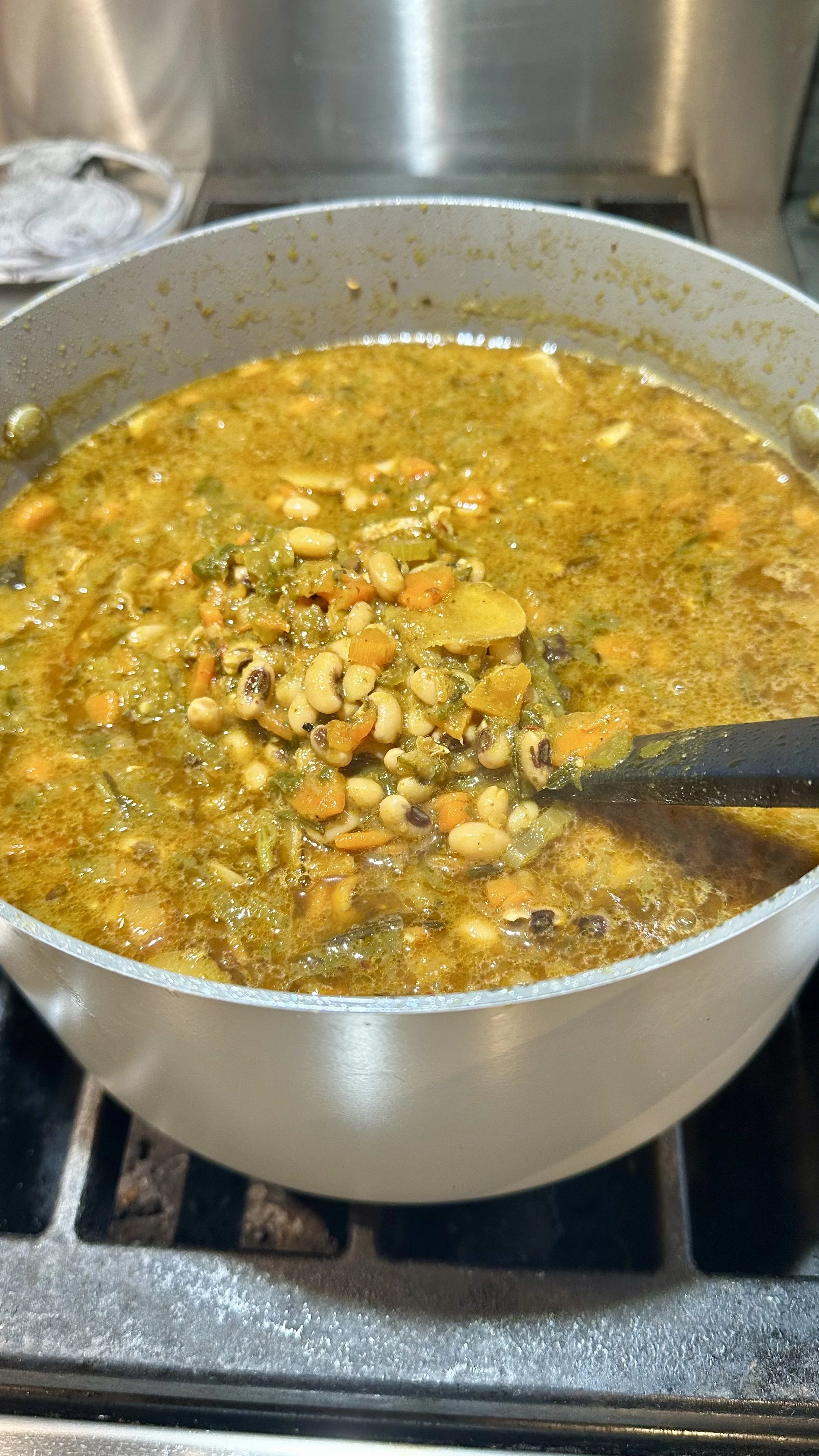
A simmering pot of brothy beans
Method
Warm a stockpot over medium heat, then add olive oil, spices (excluding salt), and bay leaves. Allow them to bloom briefly.
Add the vegetables and sauté until softened.
Add the beans and their soaking liquid, then enough water to cover by about two inches. Add kombu if using, along with any herbs such as epazote, tarragon, or oregano.
Increase the heat and bring to a hard boil for 10 to 15 minutes, then reduce to a simmer.
Once the beans begin to soften, season with salt and acid to taste. Thin-skinned black-eyed peas should start to soften after the initial hard boil.
Continue simmering, tasting, and testing until the beans are tender. Pre-soaked field peas that are less than a year old are typically done in about two hours.
Serve over rice, or with some crusty bread for soaking up broth.
I serve these alongside collard greens, prepared in a Brazilian style. The greens are sliced thinly and quickly sautéed until just tender and bright. I add garlic toward the end so it does not scorch and turn bitter. Optional additions include grated ginger, a touch of sesame oil, and a splash of acid such as lemon juice or black vinegar. Feel free to use whatever leafy green is calling your name.
Carrying the Right Things Forward
As this year closes, we are less interested in perfect plans and more interested in thoughtful direction, spaciousness, and intentionality.
What are you choosing to move toward?
What values do you want to anchor?
What rhythms do you want to protect?
However you mark the transition into the new year, quietly or communally, with goals or with rest, we hope you do it with intention.
And maybe with some warm, brothy beans.