A Survival Guide to Self Isolation and Working From Home

Photo courtesy of Unsplash.

Photo courtesy of Unsplash.

Hello, and welcome back to the Two Piers podcast, Season One, Episode Four. This week, in the midst of the global coronavirus pandemic, we’ll be sharing some ways to stay grounded while we transition to self-isolation and working from home. We also recognize that many folks are taking on the additional transition of having kids home from school during the day which can add an entirely new set of challenges to navigate. More than that, people are dealing with an incredible amount of stress. We are facing risks and uncertainty in many structural areas of our life, such as access to medical care, the financial system, etc… So, when those feelings of panic or anxiety start to rise, focus on what you can do, rather than what’s outside your sphere of control. The entire world is facing this crisis together. Before we get started, we want to say a sincere thank you to the medical professionals out there fighting this pandemic and putting their own lives at risk. We appreciate everything you’re doing. 

So, we’re going to try to keep this podcast relatively light-hearted and very much tactical, because there’s enough existential dread out there to last a while and we need to focus on what’s actually within our reach. In that vein, let’s start with some small silver linings to self-imposed isolation.

We can think of a few...

  • Firstly, yoga pants! (or maybe no pants?)

  • Also, you finally get a chance to use that leave-in conditioner you’ve been wanting to try 

  • And a big one: pet cuddles, on draft

But we also know there are some serious downsides as well, including:

  • Lack of structure

  • Isolation

  • Boredom, depression, or feelings of suffocation

We’ll start out discussing strategies for staying sane and healthy while social distancing and self-quarantining, then we’ll address the ever-controversial “working from home.”

First of all, are you an introvert or extrovert? Be prepared to be affected differently depending on how you naturally re-energize. Personally, I’m an introvert, (so shout out to my other introverts that are at the ready with their recommended reading lists), but even I am susceptible to cabin fever, so my heart goes out to the extroverts who are suffering magnitudes more. We’ll try to highlight where certain advice might be more applicable depending on whether you’re an introvert or extrovert.

One piece of advice that we’ll offer universally is to take control of your environment. Being amongst clutter is a big environmental stressor - it can act like static noise in the background of your life. So put the time in now to get your environment as welcoming and calming as possible. It will pay back dividends in your mental wellbeing and your productivity. If reorganizing your home office or bedroom feels incredibly daunting, maybe try gamifying it. Give different tasks or rooms different weights and give yourself points and some small rewards at the end of the day or week. In these times where we can feel a loss of agency, taking control of our environment can be really therapeutic. There are enough legitimate things to worry about. Let’s not allow that pile of shoes in the corner be sucking up any of our positive energy. 

Another universally applicable piece of advice is to get some sunshine and fresh air, even if that means it’s only on your front porch or stoop. Maybe take a coffee break on your balcony or patio. If you can’t squeeze in any natural sunlight, then we suggest investing in a full spectrum light for your workspace or kitchen, as well as some Vitamin D supplements. Both of these can impact energy levels and overall mood. It’s really important to keep an eye on your mood level, by the way. It’s easy to get caught up in a negative spiral and without others around to help keep us regulated, we might not even realize how poorly we’re feeling until we’re really in a lurch, at which point judgement and perspective can be skewed. If you’re suffering from depression or experiencing self-harm or suicidal ideation or thoughts, please reach out to the National Suicide Prevention Lifeline at 1-800-273-8255, or if you prefer text to speaking, text HOME to 741741 for the crisis text line. 

Now is the time to be scheduling video calls with loved ones and long lost friends, especially if you’re feeling isolated. Just beware of the draw of social media. When we’re craving interactions with others, Social Media can end up feeling like a supplement, but it can be a one-way feed and can sometimes make us feel even worse. It can be good in doses, but it can also become a black hole for your time and energy. If you come away from a Social Media binge feeling refreshed and motivated, then great! I know that for many of us, however, it can be a time sink, and we feel more anxiety rather than less. This is where time-blocking can be key. We’ll discuss this more a bit later. 

So how about some self-care options. Do you have that drawer full of fancy beauty products or bath bombs that you never actually use? Well now’s your chance. Taking a bath can be a great way to get ready for bed, especially when your mind is in a million different places and you’re struggling to get it to quiet down. I feel like we all probably have that pedicure kit that someone got us as a gift that’s never gotten used. Well, mine is making an appearance this weekend. Maybe try out that weird charcoal mask in the bottom of your drawer. If it leads to a breakout, it’s pretty low stakes and now you have permission to throw it out. It’s also a good opportunity to pause some of your beauty routines for a reset, like plucking eyebrows, getting your locks trimmed or shaving your legs. Always wanted to try waxing your legs instead? Well now’s your chance to go fully wooly so you can try a different depilation method once all this is over. Want to change your eyebrow shape? Let those brows grow back in and start with a clean slate. I’m in the middle of growing out a pixie cut, so when I do finally go to see my stylist, she’s definitely going to have more to work with. 

This one might not be super popular, but it’s a big one: try to limit alcohol and binge eating or mindless snacking. Alcohol is a natural depressant, and right now, that might not be what you need, even if you think it’s going to make you feel better. You’re also probably getting less activity in, so increasing your calories can make you feel lethargic and it can start adding weight during a time when we don’t need to be increasing comorbidity risks. Also, importantly, it can end up being a crutch that masks boredom or depression and there are much healthier, more effective ways to tackle those two maladies. Next time you reach for the fridge outside of mealtime, ask yourself whether you’re really hungry, or you’re just bored.

If you feel like your brain is starting to turn to mush, try learning something new or try mastering something old:

  • experiment with new recipes 

  • Try an online yoga class or dance class 

  • Check out edX or Lynda.com for online college courses

If you need some more passive mental stimulation, consider video games. For extroverts, maybe a multiplayer game with friends or relatives. There are also great video games for introverts as well, and they’re not all first person shooter games. Consider trying some puzzle games to give your brain a change of pace without complete vegetation. I don’t normally play video games much, but I am a big fan of Tetris Effect because it really helps me reach a state of flow. For a throwback game, Animal Crossings is out for Nintendo Switch this week. 

Another option to keep you busy and help with isolation is to try fostering an orphaned animal. It’s not a permanent commitment, but it will certainly make an impact on an animal’s life, and provide some companionship and cuddles in the short term. Reach out to your local animal shelter to find out about foster programs. 

So a few words about self-quarantining with a partner… Communication. Communication. Communication. Don’t let things fester. We don’t know how long this will drag out, or when we’ll finally be able to come up for some space and air, so you’re going to have to communicate in real time about how you’re feeling so you can each treat each other conscientiously. Personally, I highly recommend taking the love language quiz. It can help you better understand how to show your partner love in the way they value most, and it can also help you understand when they might be trying to show you love, just in a different way than you’d normally prefer. On a more tactical note, try setting up individual personal space. For us, I work in my home office in the front of the house and my spouse works in the back of the house. We only see each other for lunch, or if we text each other asking for a coffee refresh while the other is on a call. Also, if you can afford it, buy some noise cancelling headphones. This lets him play video games while I work on podcasts, or read my book. We are still cohabitating, just separately at times. 

On a more somber note, instances of domestic violence spike during times like these. If you are at risk, or know someone who is, please reach out to a local crisis line. These are trying times, pressure is high, and we’re all locking ourselves away together so tempers are bound to flare. You can reach the National Domestic Violence Hotline at 1-800-799-7233.

So now we’re going to switch gears and talk about working from home. 

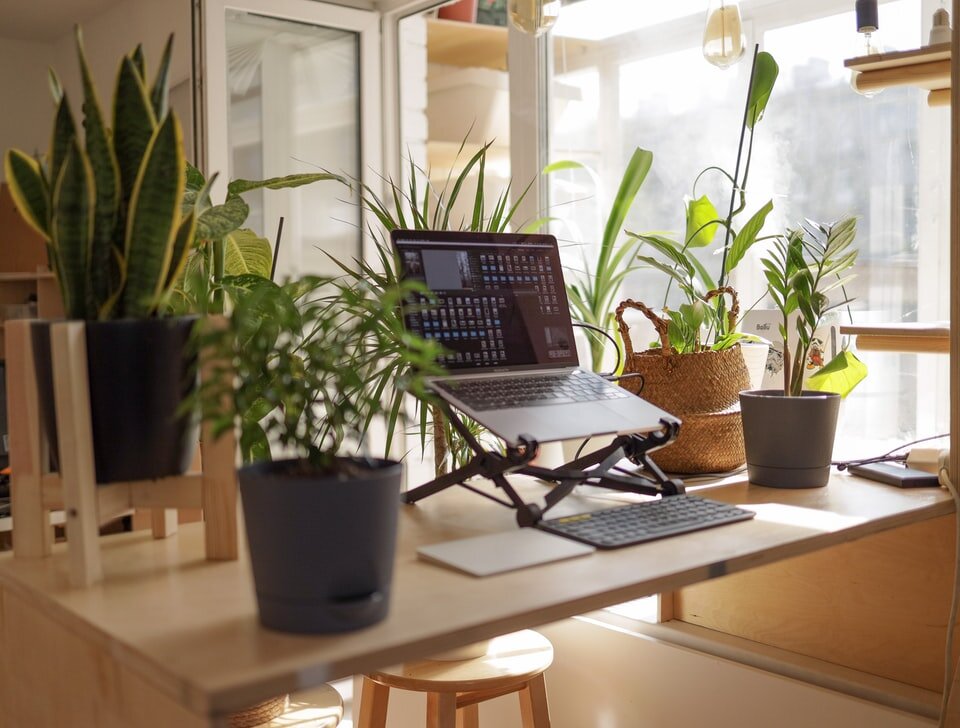
First thing’s first - get yourself set up properly. If you can afford it, try to get a decent chair and desk combination, or even work standing up. If you’re on calls all day, invest in a comfortable headset. When I was working from home regularly, I invested in a sit-stand desk and a full-spectrum light because they really helped with my energy levels, especially when I was taking early morning calls and it was still dark out. I also bought some IKEA art for the walls and a fake plant so that I had pleasant surroundings. This stuff might seem trivial in the midst of a pandemic, and you may not have the budget for new purchases right now, but there are options that won’t hit your wallet. Find a way to print or clip something at home that’s aesthetically pleasing, or even an encouraging quote to put up somewhere within your line of sight, and maybe pick a few green things from outside to put in a glass of water to add some flora to your space. It doesn’t have to be complicated or expensive, and I promise you that it will help. 

Now we’re going to talk about structure. Your day may already be quite structured if you have lots of meetings, like I do. If not, you can add structure to your day by setting up a calendar and time blocking. This applies to physical space as well. Keep your work space separate from your relaxation space if at all possible. This may simply mean two different chairs on opposite sides of the room if you’re in a studio, but trust me, it helps. When you do take any kind of extended break from work (i.e. more than a 5 minute browse of the news), try not to do it in your work space. For example, take your lunch at the table, or near a window. This segregation of space and time will help your relaxation feel like relaxation, and it will help your workday feel more productive. When work and relaxation start to blur together, it can impact our perception of quality for both. It’s hard for us to feel like we accomplished work during the day if we’re doing it from bed, and it’s hard to feel like you’ve really put work aside at night if your scenery hasn’t changed at all. 

You might be used to casual conversation with colleagues. These interactions provide valuable intellectual stimulation that can help stave off mental fatigue and spark creativity and problem solving. Even if you think you’re just chatting about weekend plans or debating mortgage refinancing, your brain is getting a much needed break. If you’re working from home on your own, find your mental break another way. You could do a video chat coffee break with colleagues, or schedule 10 minutes to watch cat videos on Instagram or browse Buzzfeed for memes. Again, time-blocking is key, and there are some great apps out there that can help you add structure so you don’t end up sucked into the blackhole that can be the internets. “Workflow Timer” and “Sloth - Task Manager” are two very basic apps that can help with time-blocking. 

For meetings, try mixing in video calls, should your hair allow, and don’t feel like you need to be all dolled up. Just getting to see people’s faces, shiny skin, matted hair and all, will help us relate as humans. We also recommend you practice your muting and unmuting skills because you do not need the stress of an unmuted faux pas. If in doubt, say “can you guys hear me?” loudly before yelling at the dog. Along those same lines, take the time to learn how to share your screen properly. If you need help, just ask. And as we’re all supporting each other right now, try to be forgiving of the background noises. Yes, Joey’s loquacious 4-year old might be breaking your train of thought, but everyone is doing their best. Conference call background noise is an excellent opportunity for us to exercise our focus muscles. If you’re finding that those muscles have atrophied since your college cramming days, don’t punish your colleagues. Instead, try some 5 minute meditation sessions on Headspace or Calm to get better at it! A few times a week will start to make a big difference in no time at all. 

Lastly, if you’re a manager, recognize that different people thrive in different environments. If you’re worried about your team’s productivity, rather than micro-manage or make assumptions, set specific objectives and milestones with clear deadlines, and schedule regular check-ins so that any barriers or challenges can be surfaced early for your intervention without you needing to micromanage. 

For the folks out there working from home and sharing their space with kids, and/or trying to homeschool, you’ve got this. In our household, we’re just managing furkids, and we’re not experts on homeschooling, but there are lots of resources popping up on the internet. Frankly, if the kids simply become experts in folding clothes and mowing the lawn over these next few weeks, it will still serve them well in life. This isn’t going to make or break their career chances, so give yourself a pat on the back and take a deep breath. 

If we have one overarching piece of advice, it’s to focus on compassion, be flexible, and let go of the small stuff. Schedules will be disrupted. We won’t perfectly master the new work life balance. But that’s ok. Find normalcy where you can and cherish your loved ones. 

If you have any questions or need some support, please reach out to us on whatever medium you’d like. Our contact information is on our website at www.twopiersconsulting.com, and we’re on Twitter, Instagram, Facebook and LinkedIn as well. We look forward to hearing from you. We’ll meet you back here soon, and in the meantime, stay home and stay safe.

Two Piers Talks International Women's Day

Photo courtesy of Unsplash.

Photo courtesy of Unsplash.

Hello and welcome to the Two Piers Podcast, season one, episode three. I’m your host, Erica D’Eramo. Today we will be discussing International Women’s Day. We’ll touch on the history and purpose behind this celebration, as well as this year’s theme and the underpinning six missions. We’ll also explain how you can personally get involved.

International Women’s Day occurs on March 8th each year. This year it’s on a weekend, which means you’ll probably be hearing about it in various forms throughout this preceding business week whether on LinkedIn or Social Media, or through events at your company or community. 

You may be wondering about the story behind International Women’s Day, and perhaps you think it’s a recent phenomenon. In reality, IWD has a long history that dates back more than a century. Only in recent years have we started to see more recognition in the US, due in large part to our more globally connected society and the impact of corporate events and social media. 

My first experience with International Women’s Day was while I was living in Azerbaijan and working in the Republic of Georgia, both of which were formerly part of the Soviet Union. IWD was an important Soviet holiday and it remained important in the post-soviet era. My experience in the early 2000’s in Baku and Tbilisi was that IWD was predominantly focused on displays of respect and gratitude toward women. I did find this a bit ironic, as the women were often responsible for any cooking or cleaning required for an IWD celebration, at least at the sites where I was working, but it was a fun day with lots of flowers and chocolates and odes to women’s greatness. I also experienced International Women’s Day while I was working in Angola. It was similarly celebrated with flowers and chocolate, and displays of respect toward women. The similarities made sense to me, as Angola has had a historical relationship with the Soviet Union and now modern day Russia. I found IWD to be similar in some ways to Valentine’s Day, but without the romantic element. Instead, it was a display of affection, support, and sisterhood for the women in those societies.

As mentioned previously, International Women’s Day has a long history, dating back more than a century. The early 1900s saw organizing and activism by women fighting for better working conditions and voting rights which laid the groundwork for IWD. In 1908, there was a protest of 15,000 women in NYC. The following year, the Socialist Party of America declared February 28th National Women’s Day. Then, in 1910, at the second International Conference of Working Women in Copenhagen, a woman named Clara Zetkin proposed what we now recognize as International Women’s Day. This proposal was unanimously approved and IWD was born. 1911 saw International Women’s Day honored in Austria, Denmark, Germany and Switzerland with more than a million people attending rallies. By 1913, it was being celebrated in Russia. The following year, in 1914, the official date was changed to March 8th, (on the Gregorian calendar) and it has remained as that date even since. 1914 International Women’s Day celebrations saw rallies across Europe, including in the UK, where Sylvia Pankhurst was arrested in London while on her way to speak to a crowd at Tragalgar Square about women’s suffrage. Sylvia was the daughter of Emmeline Pankhurst, who features in a great Drunk History episode, by the way.

Another interesting fact is that the Russian revolution was kicked off in 1917 with protests associated with International Women’s Day. Women began protesting on March 8th for bread and peace, and less than a week later, the Czar had abdicated. IWD would maintain a high prominence throughout the Soviet era.

By 1975, the UN had begun recognizing International Women’s Day. The website was created in 2001, and the online presence and corporate sponsorship and involvement has grown over the years with the expansion of social media and ESG focus. 

So what is the purpose of this day? Honestly, the purpose varies depending on the country and context. In some areas, the day is seen as an opportunity to celebrate women and demonstrate respect. In other areas, it’s seen as a day for protest and galvanizing action. The global campaign is directed primarily at raising awareness regarding the issues facing women, and increasing access to resources.

Sometimes I get asked whether International Women’s Day is inherently sexist. Well, we at Two Piers certainly don’t think so. Firstly, we believe the entire world benefits from gender parity and that enabling women to access their potential will reap benefits for all humans. Secondly, we also recognize International Men’s Day on November 19th, which raises awareness about the issues facing men and works to dismantle biases and myths that impact men. Forcing people into boxes is harmful and inefficient for society, regardless of gender. 

Each year, a primary theme is set and this year’s overarching theme is “Each for Equal.” According to the website: “The IWD 2020 campaign theme is drawn from a notion of 'Collective Individualism.' We are all parts of a whole. Our individual actions, conversations, behaviors and mindsets can have an impact on our larger society. Collectively, we can make change happen. Collectively, we can each help to create a gender equal world.”

Along with the theme, there are also six missions that are identified, in which “celebrating women's achievements and increasing visibility, while calling out inequality, is key.” We’ll touch on each of the six missions here. 

The first mission is Women in Tech: To celebrate digital advancement and champion the women forging innovation through technology. The site discusses the need for more women in tech, and has some great videos and articles outlining exciting technologies that are shaping the world for the better. This includes food waste reduction, interface design for better inclusivity, and “Smart Dust” a quantum computing technology to tackle drug diversion and abuse. There’s also a section that explores the implications of gender bias in AI. Frida Polli, CEO of Pymetrics has a thought provoking challenge “Can you imagine if all the toddlers in the world were raised by 20-year-old men? That’s what our A.I. looks like today. It’s being built by a very homogenous group." If we think about the implications across all the sectors utilizing AI, it’s pretty astounding.

The second mission is Women and Sport: To celebrate women athletes and applaud when equality is achieved in pay, sponsorship and visibility. We at Two Piers are big supporters of the US Women’s National Team in soccer (or football as the rest of the world calls it). We recommend Googling the USWNT’s lawsuit for pay equality. There have been some great articles over the past few weeks, including one from SB Nation explaining the current arguments behind the suit, and another from ESPN detailing the support from the US Men’s National Team union.

The third mission is Women at Work: To champion women of all backgrounds who dare to innovate, lead, and uplift others towards a more equal and inclusive workplace. The Global Gender Gap Report for 2020 is available from the World Economic Forum. There are lots of great infographics and a whole bunch of detailed analysis. There’s also a very disappointing extrapolation: at current rates, we are still an astounding 99.5 years away from gender parity. We need to do more.

The fourth mission is Women Entrepreneurs: To support women to earn and learn on their own terms and in their own way. This one hits close to home, as Two Piers is the product of female entrepreneurialism. One article discusses the shift from freelancer mindset to founder mindset: Seth Godin of “The Inner Entrepreneur” defines the difference between being a freelancer and an entrepreneur. He explains that "Freelancers get paid for their work. If you're a freelance copywriter, you get paid when you work. Entrepreneurs use other people's money to build a business bigger than themselves so that they can get paid when they sleep.” Some of the benefits for women as entrepreneurs are economic and creative independence in which women can take control of their own work. Other benefits include finding balance, whether work-life balance or balance between interests, and it allows you to channel your motivations and passion. 

The fifth mission is Women’s Health: To assist women to be in a position of power for making informed decisions about their health. We know from extensive studies that gender bias exists in medicine, whether in the exam room and doctor’s perception of women’s pain, or in research studies that exclude women. One area of medicine that gets explored on the IWD site is heart disease. The British Heart Foundation's briefing, 'Bias and Biology', revealed these four findings:

  • women are less likely to recognize symptoms of a heart attack than men

  • a woman is 50% more likely than a man to receive the wrong diagnosis

  • women are less likely than men to receive life saving treatments

  • women are less likely to be given medicine to stop a second heart attack

You can be aware of the following five signs of a heart attack in women:

  • chest pain or discomfort that happens suddenly and persists, like pressure, tightness or squeezing

  • pain can then spread to the left or right arm or to the neck, jaw, back or stomach 

  • sickness, sweating, light-headedness or shortness of breath

  • sudden anxiety similar to that of a panic attack

  • excessive coughing or wheezing

We encourage you to be on the lookout for these signs.

The sixth and final mission is Women Creatives: To increase the visibility of women creatives and promote their work for commercial projects. The International Women’s Day site includes highlights of female artists and the IWD 2020 Typography Contest. If you’re a female creative, we highly recommend you check it out.

So you might be wondering how you, personally, can engage or get involved. Firstly, check out the website at www.internationalwomensday.com You can learn more about what’s going on this year, and can even find and attend an existing event. If you’re thinking of hosting your own event, the website has all sorts of resources to get you set up and on your way. You can also use the hashtags on social media to both follow and amplify. This year’s are #IWD2020 and #eachforequal.

So that wraps up our coverage for International Women’s Day this year. We’re looking forward to celebrating, and you can watch our social media channels for more information and resources on IWD 2020. In our next podcast, we’ll be sharing some exciting news about Two Piers and our plans for the next year. I’m so excited and want to shout it from the rooftops, but I’m going to save it for later this month. As always, be sure to follow us on social media. We’re on Facebook, Twitter, Instagram and LinkedIn, where we share lots of great content and resources. If you’re interested in our coaching, workshop or consulting offerings, you can find out more on our website at www.twopiersconsulting.com, and inquire directly.

Thanks for joining us for this third episode of our podcast, and we’ll meet you back here soon with our new announcement. 

Women in Leadership Conference - Recap

Photo courtesy of Unsplash.

Photo courtesy of Unsplash.

Hi! Welcome to the Two Piers podcast. I’m your host, Erica D’Eramo. During our second episode of season one, we’ll be recapping the 20th annual Rice Women in Leadership conference. 

Ally Cedeno, founder of WomenOffshore kicked it off with a rousing welcome. She and her team did an incredible job pulling together speakers and content that struck a great balance. The sessions were realistic and honest, while remaining inspirational and energizing. We can’t cover all of the speakers and panelists, but we’ll try to cover a large portion of it. 

The opening keynote was masterfully presented by Ann Fox, a Marine Corps veteran and the president and CEO of Nine Energy Services. Her humor, humility and honesty made for a powerful, and at times heart-wrenching discussion. She reminded us that having a diverse set of perspectives can make the difference between life or death at times. 

From there, we had a choice of four morning panel sessions - I attended the Founders Corner: From Vision to Adventure. The panelists included Jillian Fink, CEO and Co-founder of OcciGuide, a medical device company; Kathleen Perley, CEO and Co-founder of Decode Digital, Diana Murakhovskaya, co-founder and General Partner, The Artemis fund, and Erin McClarty, Founder, Erin McClarty, PLLC. Side note: we’re big fans of Erin over here at Two Piers and we’ve been working with her for some time now. 

We learned from Diana that in 2019, only 2.8% of VC money went to companies founded by women, however 19% of all exit value comes from female founders. We clearly have some work to do.

One key theme was around what constitutes success versus failure.

Kathleen discussed the definition of a win and identifying the right KPIs or key performance indicators. In fact, testing out ideas and knowing something’s not right - that can be a win. Erin focused us on identifying what success was for us, and whether we’re working toward that. One helpful tactic is to identify what you’re “not” going to be. 

There was also a theme around structure, including blocking out time and setting boundaries, with yourself, your clients and your loved ones. It’s important to set aside time for reflection and strategy. Within your daily structure, we must make sure there’s a focus on what makes money, with an understanding that it needs to be both short term and long term revenue. The panelists also discussed setting aside a separate space or office to work in. Finding a coworking space or partner can also help add structure. 

One great question from the audience that we felt was particularly insightful: for over-achievers that are not used to having risks, how do we face potential failure? Erin suggested that communities such as the one at the Women in Leadership Conference, create the space to fail and share. Kathleen credited her academic struggles with dyslexia for teaching her how to get comfortable with failure and move on quickly. It doesn’t hold her back. Jillian recommended doing your research such that you have the confidence to go your own way. 

In parallel with the Founders Corner, was the Lessons Learned in Leadership panel. This included the following panelists:

  • Lynda Clemmons, VP sustainable solutions at NRG discussed the value of listening to where people are at

  • Sruba De, Vice President, Global Retail Insights & Solutions, Mastercard Advisors, discussed what makes a good leader: powerful communicator, ability to influence, thriving outside comfort zone. Sruba also discussed the importance of having our own set of personal directors: someone believes in you, mentor to sponsor, biggest critic. These should be people that have directly seen us work.

  • Tandra Jackson, Managing Partner, KPMG discussed servant leadership and putting the client first

  • GiGi Lindberg, VP and Commercial Relationship Manager, BBVA and Founder and CEO, Meritaj discussed tactics for, and importance of, responding rather than reacting. 

Midway through the day, we took a break for a networking lunch and met some of our fellow attendees. 

The afternoon included a selection of workshops, and Two Piers facilitated a session on Tough Conversations. So why this topic? Difficult conversations affect everyone. Fundamentally, we have a few choices - we can try to avoid them, we can handle them poorly, we can handle them well. We all know people that can handle them well. We discussed our intended learning outcomes:

  • Recognize what makes difficult conversations difficult

  • Identify tools to prepare for them

  • Understand ways to navigate confrontation and de-escalation 

  • Determine how to close out and resolve these interactions 

We won’t re-work the workshop here, but keep a lookout for a future podcast dedicated to navigating conversation. We had some great questions from the end, and have picked up some ideas for how to make the content even more valuable. 

While we were in the Tough Conversations workshop, Delifina Govia was facilitating her workshop called “How to Live for 300 Years - Maximize Your Personal and Professional Life” Delfina is a partner at Veritas Total Solutions, and we’re big fans of her here at Two Piers. Her interactive workshop focuses professionals on balancing their personal and professional lives. This was far from a lecture - it was a working session that even involved a bit of math. If you missed out on her workshop at the Women in Leadership Conference, she’ll be hosting a free, extended version of the workshop on March 6th to celebrate international Women’s Day.

Following the afternoon workshops, there was a panel discussion on The Frontier of Diversity and Inclusion in Business. The panelists included:

Deborah Byers - E&Y’s Americas Industry Leader and also E&Y’s Americas Oil and Gas leader

Janelle Daniel - VP HR, Community Relations and Sustainability at Transocean

Amy Dalton - SVP Americas, BCD Travel

Larry Perkins - Assoc. VP HR and Diversity Organizations MD Anderson

The panelists discussed where they saw the future of diversity, and it’s clear they all see it as a central tenet of doing business. 

Deborah raised the issue of unspoken rules and suggested we acknowledge them and either eliminate them or get them into the limelight. 

Janelle discussed the implications for industrial environments and the need to address technical environment, such as adequate PPE or suitable changing facilities. 

Larry observed that MD Anderson has always been good on paper. We loved his assertion that diversity is a fact, whereas inclusion is an act. We also need to lift as we climb and bring future generations with us.

Deborah noted that it takes 20% of a workforce to change before we start noticing a difference. You can look great on paper but we need to focus on the right roles. 

For the closing keynote, Sandy Asch discussed the Roar Leadership Experience. She stressed  the importance of being purposeful, transparent, calm and courageous. She also spoke powerfully about velcroing yourself to your purpose. This can help you stay on track, and also  energize you when you hit challenging times.  

We wrapped up the day with a reception hosted by Dean Peter Rodriguez, whom we want to thank for his support this year and in years prior for the Women in Leadership Conference. Another shout out to Ally Cedeno and her team for a great lineup and excellent content. 

Thank you for joining us on our second podcast. You can expect another installment in two week’s time. In the meantime, you can find more content on our social media feeds on LinkedIn, Twitter, Instagram and Facebook. As always, feel free to reach out via our website: twopiersconsulting.com.

Have a great week and we’ll meet you back here soon.

Welcome to our Two Piers Podcast!

Hero image 1.jpg

We’ve included a text version of our podcast for accessibility.

Our introductory podcast gives an overview of who we are and what we do, along with some context and background regarding our philosophy. We  promise to keep these podcasts funny, engaging and relevant because your time is precious, as is space in your brain and on your playlist. So this is for you to use.

First, some background about myself. My name is Erica D’Eramo and I’m the founder and CEO of Two Piers. My career started with a Mechanical Engineering degree from Penn State University. I’ve spent nearly two decades in the energy industry, working domestically and internationally, in field-based roles and office roles, including engineering, operations management and finance. I saw, first hand, the challenges facing women, particularly those starting out in field-based roles. Following a three-year offshore rotational assignment in Angola, I decided to take a sabbatical and start this project, (Two Piers), to provide resources and support directly to women working in male dominated environments. During that sabbatical, I also conducted a study called Spot the Difference which was sponsored by BP and executed in conjunction with QuayFive - a consultancy based out of the UK.  We worked with 12 different FTSE 300 companies spanning multiple industries, each with international reach. We examined the career choices and motivations of employees and how they differed based on gender. We also examined the effectiveness of diversity and inclusion initiatives. There were some very interesting findings, which we will discuss further in a future podcast. 

So why gender diversity as a focus? For us, it relates back to engineering. We here at Two Piers hate to see waste, especially when it comes to human potential. Not only are we putting up unnecessary barriers for more than 50% of our potential workforce, but we also make it more  difficult for them to fully contribute when we have non-inclusive workplaces, or we evaluate them against how well they can conform to a masculine norm. Additionally, we see waste in the stressors this can put on team dynamics when the workforce begins to believe that gender outweighs meritocracy. This sows discord, distrust and disenchantment. We also feel that gender diversity is deeply misunderstood. Efforts to diversify a workforce and create a more inclusive environment are often seen as philanthropic initiatives as opposed to strategic business imperatives in today’s competitive, fast-changing world. In addition, gender is simply one facet of diversity, however it is more visible than many other aspects of diversity, and thus can act as an analogue to open the door to conversations on ethnicity, nationality, sexual orientation, socioeconomic diversity, neurodiversity, etc… We at Two Piers want to foster an intersectional conversation about diversity and gender.

So how are we tackling it? We are taking a two-pronged approach. We are committed to alleviating the current pain points of gender imbalance for those currently in the workforce by supporting individual women through workshops, coaching and resources such as this podcast. Some examples of focus areas are:

  • Navigating pitfalls of masculine workplaces

  • Setting and asserting boundaries

  • Handling difficult conversations and confrontations

  • Individualized coaching and planning

Some might ask whether a focus on equipping women with tools and tactics is paramount to victim blaming. Why should women change to fit the environment, as opposed to the environment changing? Well we fundamentally believe that women should not, in fact, have to change, however, we like to use the analogy of going to Mars. In the short term, we need some special toolkits  in the first place - you can consider these our psychological oxygen tanks, until there are enough successful women and enough systemic change to create the atmosphere that we want and need. To turn a blind eye out of squeamishness is to reject reality and set people up for failure. At the same time, equipping women with survival tactics is not enough. We need to address the systemic root causes by working with organizations.

The organization and corporate work that we do focuses on creating systemic and sustainable change. It also supports and sustains the resources that we provide to individuals. When working with organizations, we first focus on understanding the true baseline using leading and lagging indicators. We also examine the effectiveness of current initiatives and what some of the unintended consequences may be. From there, we determine an action plan and measures for how to reach the group’s goals. We don’t just look at the numbers and percentages, but rather take a more holistic approach. 

So why a podcast? We wanted to make some of our resources and content easily and readily accessible, particularly for those individuals who can benefit immediately. Perhaps it’s difficult to attend a workshop in person, or perhaps someone’s not not ready to ask for help or scheduling a coaching session. Podcasts can remove some of those barriers to access. It also gives businesses an opportunity to sample our offerings and see whether our ethos is a good fit for their company.

Podcast episodes will focus on two different areas. We will look at strategic topics and systemic issues around gender diversity in the workplace, including how we can affect change and how organizations can create diverse and inclusive environments. We will also have podcasts focused on more tactical subjects for professional women. Topics will range from  travel tips to taxes, pet adoption to car buying. We will look at what works for working women.

We want to thank you for joining us for episode one of season one of Two Pier’s podcast. Be sure  to follow us on social media. You can find us at LinkedIn, Twitter, Instagram and Facebook, or on our website at twopiersconsulting.com. We’ll be putting on a workshop this Friday at the annual Women in Leadership Conference at Rice University, here in Houston, TX. The interactive workshop is  focused on navigating challenging interactions and confrontation. It’s one of our favorite topics! Tune in next Wednesday (Feb 19) for a recap with insights from the event.

We’d love to hear  from you. Reach out to hear more about our offerings or provide suggestions on  requested content you want to hear about. Have a great week! We’ll meet you back here soon.